
How to Search Sedgwick County Court Records
Sedgwick County court records are searched through the Kansas District Court Public Access Portal, also called CaseSearch. The 18th Judicial District Court, branded locally as DC18, points the public to this statewide tool. You can search by party name or by case number. The portal covers civil, criminal, traffic, and many family and probate case listings, though some documents are held back by court rule. The court also lets you view records on public computers at the Records Department on the 6th floor of the main courthouse.
Before you start, gather what you know. A full name, a case number, or an exact date of filing all help narrow results. Common Wichita surnames return long lists, so extra detail saves time. You will need a free account to use the online portal.
The login screen for the statewide portal is shown below, linked from the official Kansas District Court Public Access Portal.
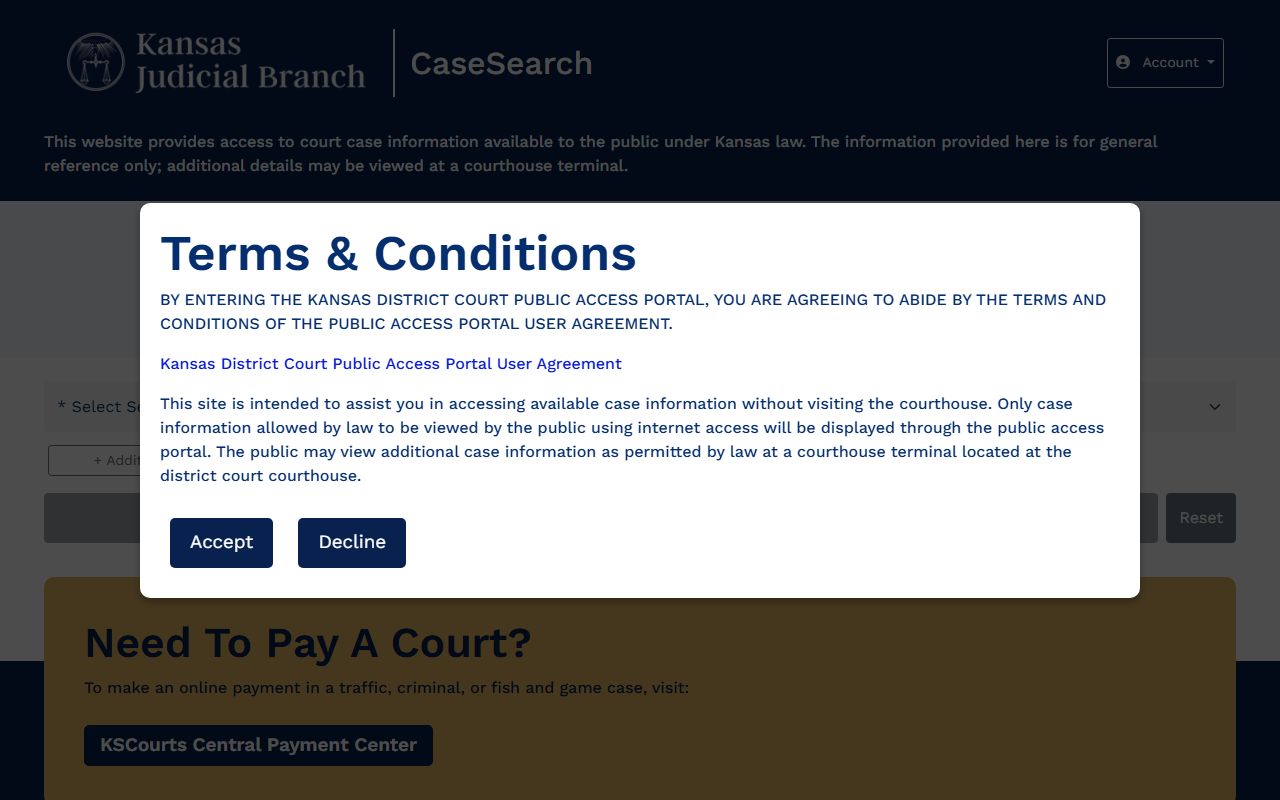
The portal asks you to register and prove you are not a robot before any Sedgwick County court records search will run.
- Open the portal at casesearch.kscourts.gov or start from the DC18 Records page.
- Create a free account and accept the user agreement.
- Enter a party name or a case number, then complete the robot check.
- Review results for case number, parties, type, judge, and hearing dates.
- Ask the Records Department for a certified copy when you need an official document.
The DC18 Records Department page, shown next, lists the portal link, contact details, and how marriage licenses are returned. It comes from the official DC18 Records Department site.
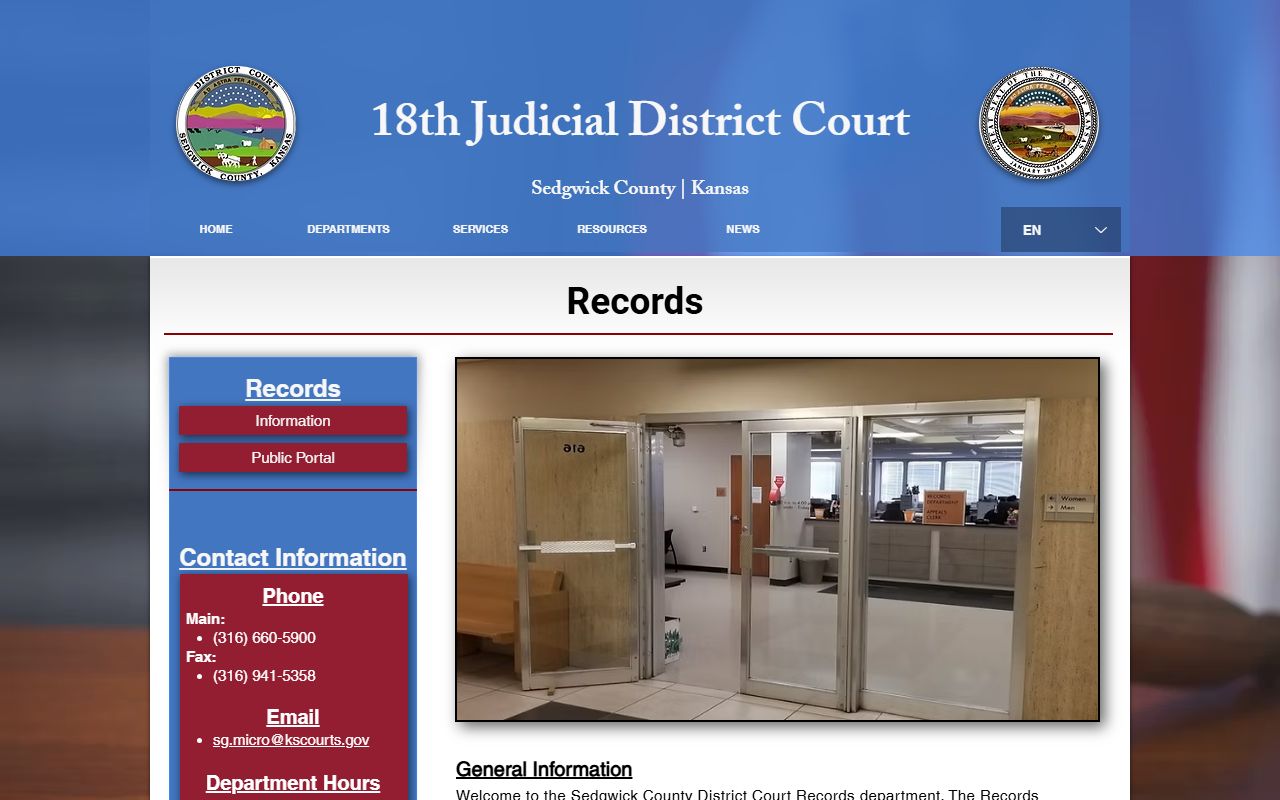
That page is the best starting point when you are not sure which department holds a Sedgwick County court record.
The Sedgwick County Judicial System
Kansas runs a unified court system with three main levels. The Kansas Supreme Court sits at the top and sets binding rules. The Kansas Court of Appeals is the middle court that hears most appeals. District courts are the trial courts, and every county has one. Sedgwick County is the entire 18th Judicial District, so the local district court handles a heavy share of the state's cases.
DC18 is large. The court reports 30 district judges plus one magistrate judge, backed by about 240 non-judicial staff such as clerks, court reporters, and court service officers. The chief judge controls case assignments and supervises clerical work. Municipal courts handle city ordinance and city traffic matters first, and the district court hears appeals from them.
Case flow: Municipal Court › District Court › Kansas Court of Appeals › Kansas Supreme Court
| Court | Jurisdiction | Case Types |
|---|---|---|
| Kansas Supreme Court | Highest court statewide | Serious criminal appeals, constitutional cases, court administration |
| Kansas Court of Appeals | Intermediate appeals | Most civil and criminal appeals from district courts |
| District Court (18th District) | General trial court | Civil, criminal, family, probate, traffic, juvenile, small claims |
| Municipal Court | City limits | City ordinance and city traffic matters |
The state explains this structure on its Kansas court hierarchy page, shown here.
The graphic shows where the 18th Judicial District trial court fits below the two appellate courts. The state's Kansas district courts page, shown next, explains the trial-court role in more detail.
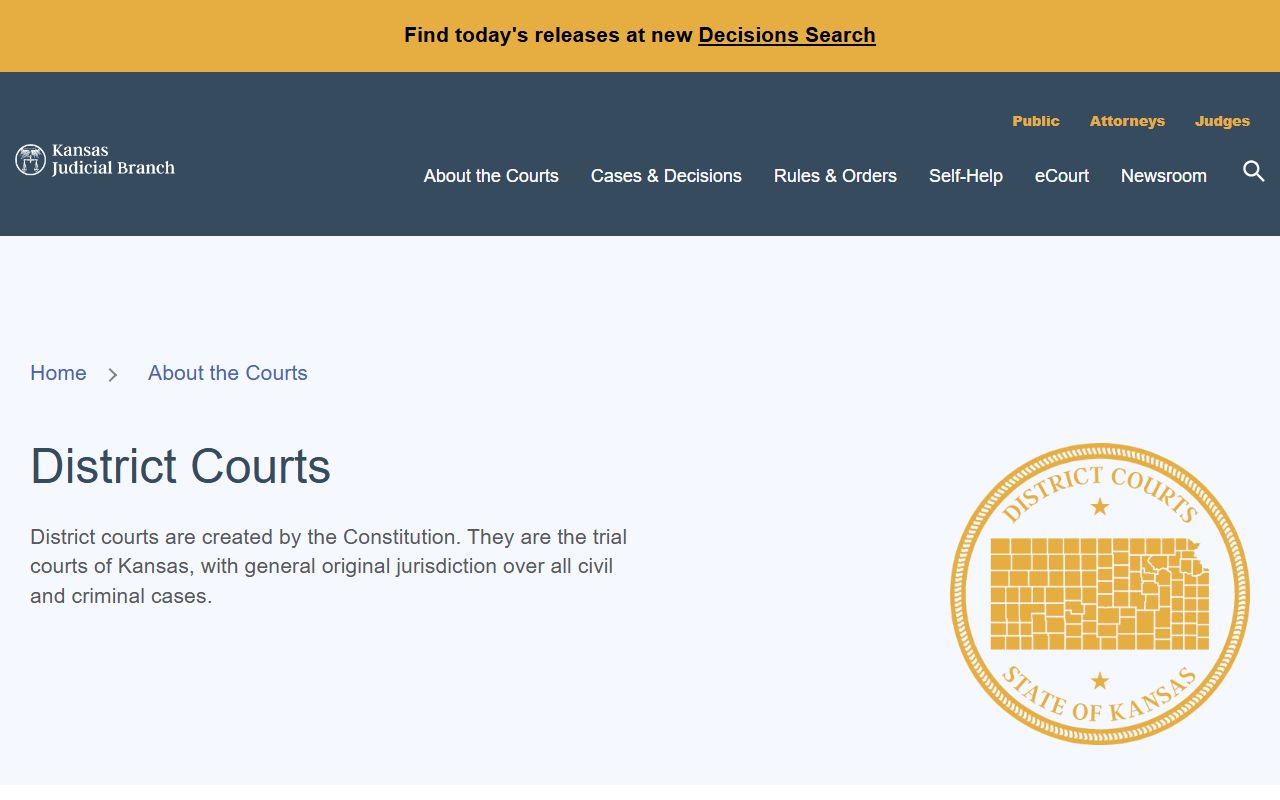
District courts hold the bulk of Sedgwick County court records because they are courts of general jurisdiction.
Sedgwick County Courthouses
Most court services run from the main courthouse in downtown Wichita. The Records Department, Civil, Criminal, Family Law, Traffic, and Small Claims work are all based there. Probate and juvenile matters sit at a separate building on East Morris Street, so do not assume every file is at the main address. The District Attorney's office is part of the same downtown complex.
Court details for each division appear on the DC18 About page, pictured below.
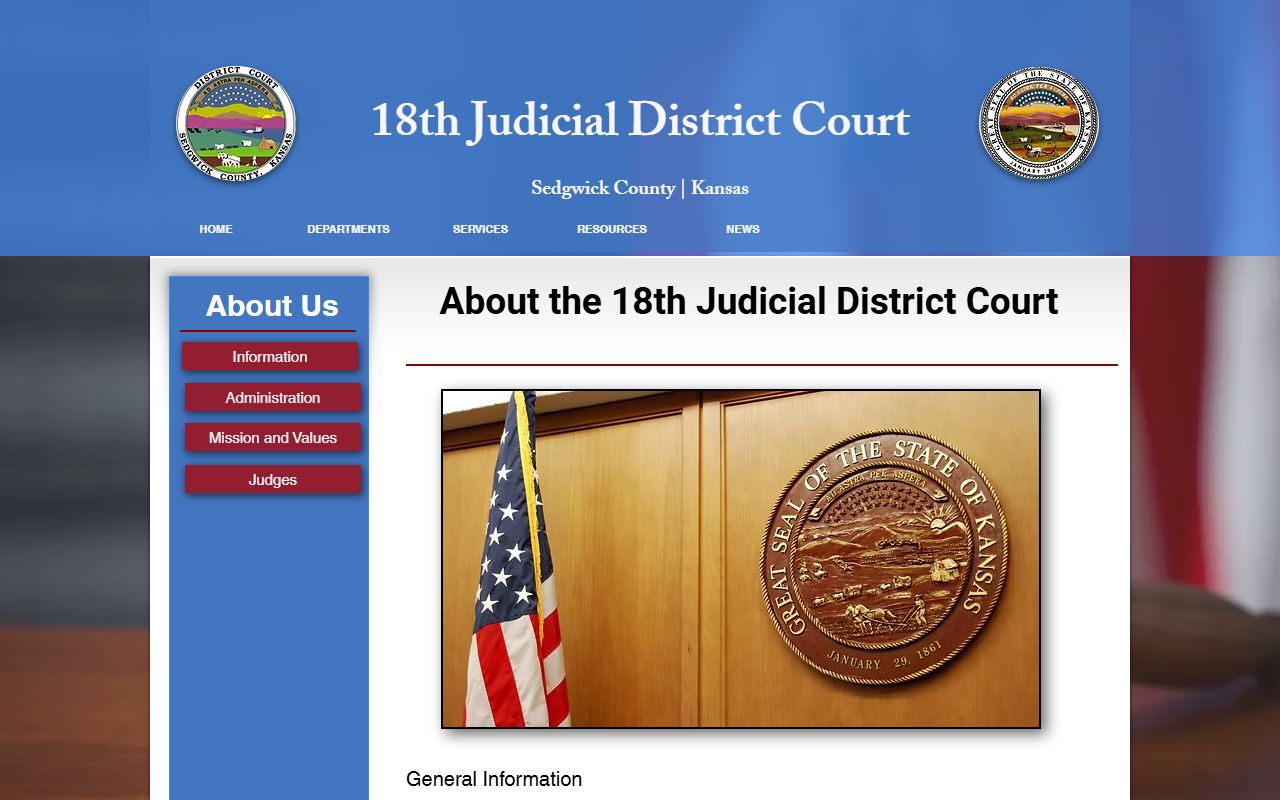
It lists judge counts, staff size, and the broad jurisdiction of the Sedgwick County trial court.
Types of Court Records Available in Sedgwick County
The Sedgwick County Court keeps records by department, and each one handles a different slice of cases. Civil filings are the heaviest load, with about 27,000 civil cases a year and more than 20,000 in the limited civil area alone. Criminal, family, traffic, and probate departments round out the record set. Most public case information can be searched, but some files are sealed or held off the public portal.
The split matters because the office that made the record is usually the office that can certify it. Here is the broad mix kept by the court.
- Criminal records - felony and misdemeanor cases, search warrants, and inquisitions, about 3,000 a year.
- Civil records - foreclosures, contract suits, evictions, name changes, and money claims.
- Family and divorce records - divorce, paternity, support, and protection cases, about 8,500 a year.
- Probate records - estates, guardianships, conservatorships, and adoptions, about 2,700 a year.
- Traffic records - sheriff and highway patrol citations, about 20,000 a year.
For a deeper look at any one type, the Sedgwick County court records page breaks down each portal and field.
What Sedgwick County Court Records Show
A Sedgwick County court record holds a set of standard fields. The case number is the key identifier, and you should use it when you ask for copies. The record also shows the parties, the case type, the filing date, the assigned judge, and a list of events. Money items such as fines, costs, and bonds appear too. Some details are redacted by law, including Social Security numbers and victim information.
| Field | What It Shows |
|---|---|
| Case Number | Unique ID for the case; use it to request copies. |
| Filing Date | Date the case was opened with the court. |
| Parties | Plaintiff, defendant, petitioner, respondent, or estate. |
| Charges / Cause | The crime charged or the civil claim raised. |
| Disposition | Outcome such as guilty plea, dismissal, or judgment. |
| Sentence / Judgment | Penalty, award, or order entered by the judge. |
The portal user agreement warns that the display is not the official court record and may have errors. Treat online results as a guide, then confirm key facts with the Records Department.
Public Access Laws for Sedgwick County Court Records
Public access in Kansas rests on the Kansas Open Records Act and on Supreme Court rules for court files. The open-records law gives any person the right to inspect public records unless the law closes them. Court records add their own layer through Rule 22 and Rule 106B, which set what shows on the public portal. County departments must answer a request within three business days.
Key Statutes:
Kansas Open Records Act, K.S.A. 45-215 et seq. - sets the right to inspect and copy public records.
K.S.A. 45-218 - covers how to request records, response time, and fees.
Kansas Supreme Court Rule 22 - lists which case types stay off the public portal.
Rule 106B limits bulk data pulls, which is why the portal uses a robot check. A denial of access should cite the law, and a record can be partly open and partly closed.
Records That Are Restricted or Confidential
Many Sedgwick County records never appear on the public portal. Rule 22 holds back adoptions, care and treatment cases, juvenile matters, and protection orders. Divorce documents, guardianship papers, grand jury material, and unexecuted warrants are also closed. Expunged cases drop off the portal once a judge grants the order.
To view a sealed record, a person usually must show a legal right and ask the court by motion. The judge decides. Some files, like presentence reports and probable-cause affidavits, stay restricted even when the rest of the case is public.
Note: Even a normally public case can be sealed by court order, so a missing file does not always mean it never existed.
Specialty Courts in Sedgwick County
DC18 runs problem-solving courts that work alongside the regular docket. The Veterans Treatment Court is a voluntary program for justice-involved veterans. It runs five phases over about 18 months and pairs each veteran with a mentor. Eligibility includes military service, county residency, a discharge other than dishonorable, and VA healthcare eligibility.
A Drug Court also operates, assigned to Division 7 under Judge Rodger Woods. These programs aim to cut repeat offenses through treatment and close court contact. The Veterans Treatment Court page is shown below from DC18.
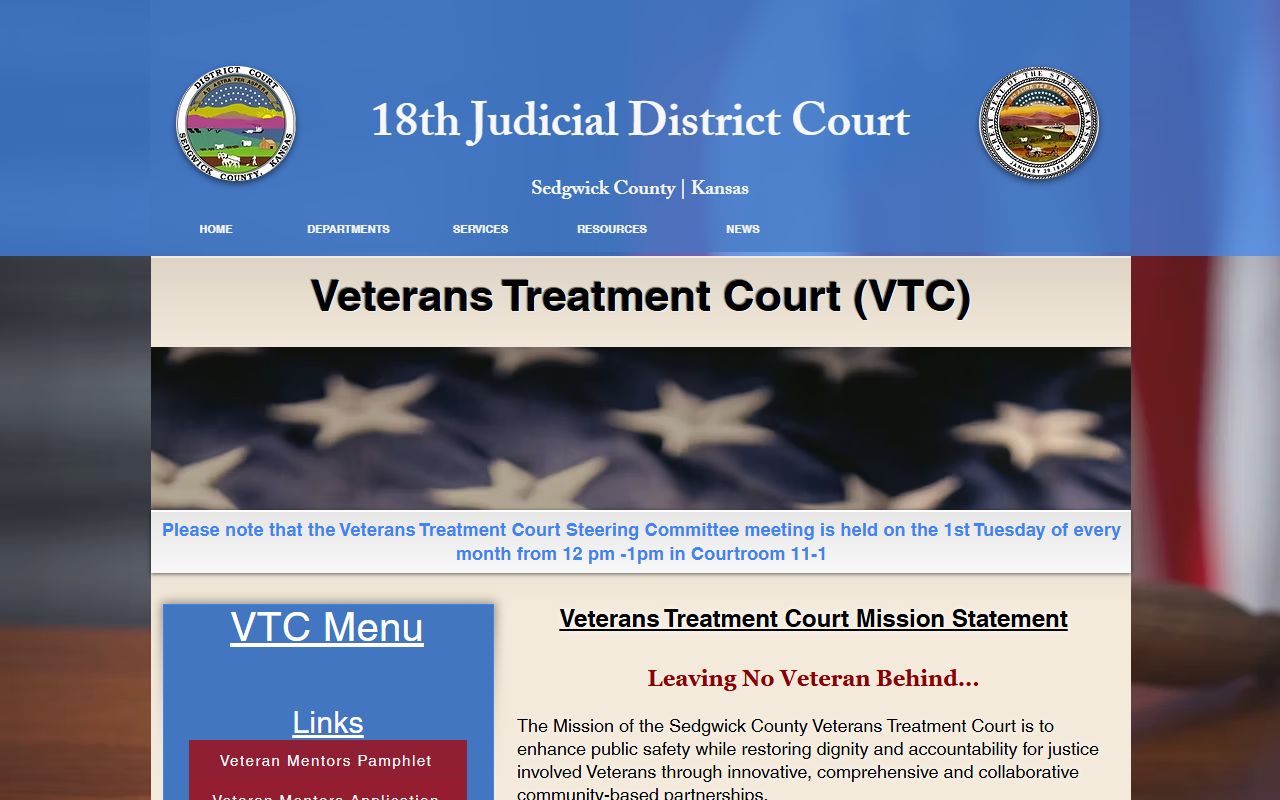
It lists program contacts, the mentor coordinator, and the monthly steering meeting in Courtroom 11-1.
Sedgwick County Sheriff and Jail
Sheriff Jeffrey T. Easter leads one of the largest law enforcement agencies in Kansas, with more than 550 employees. The Sheriff's Office runs the Adult Detention Facility at 141 W Elm in Wichita. The jail houses up to 1,500 inmates and serves as the criminal justice entry point for the county. Booking, custody, warrants, and court security all run through the office.
For a live custody check, use the Sedgwick County inmate records page, which explains the official roster. To check for an open warrant, see the warrant records page. Population trends sit on the jail population data page, and the released inmates page covers how to confirm a release.
Marriage, Divorce, and Probate Records
Sedgwick County government does not record marriages or divorces. The 18th Judicial District Court keeps those files, and KDHE in Topeka can issue certificates for qualified people. Probate matters such as estates and guardianships run through the Probate Department on East Morris Street. See the marriage and divorce records page and the probate records page for the full process.
- Testator
- A person who makes a will.
- Executor
- The person named to carry out a will and settle the estate.
- Conservator
- A person the court appoints to manage another's money or property.
Sedgwick County Court Records Fees
Court fees in Sedgwick County come from state docket-fee schedules and local orders. DC18 posts a printable docket-fee sheet and cites K.S.A. 20-3129 for added county docket-fee authority. Some service fees are fixed, and a few common ones are listed here. Records copy and certification prices are set by the court's posted schedule, so confirm them with the Records Department before you pay.
| Item | Amount |
|---|---|
| Small claims sheriff service | $15.00 |
| Small claims notice of appeal | $197.00 |
| Garnishment surcharge (small claims) | $12.50 |
| Marriage license (statewide) | $85.50 |
| KDHE certified marriage certificate | $20.00 |
Docket fees are explained on the DC18 docket fees page.
How to Interpret Sedgwick County Court Records
Court records use short codes for case types. CR marks a criminal case, CV a civil case, DM a domestic case, PR a probate case, and TR a traffic case. Knowing the code tells you which department holds the file. A charge is only an accusation, not proof of guilt. A conviction is the finding or plea of guilt that follows.
Read the disposition before you draw any conclusion. A case can be dismissed, diverted, or amended, and the final line tells the real outcome. When a docket term is unclear, the Records Department can explain procedure, though clerks cannot give legal advice.
Accuracy and Record Limitations
Online records lag behind the paper file at times. The daily docket updates every 15 minutes, but case detail can take longer to post. The portal agreement says the display is not the official record. Older files may live only on microfiche or microfilm at the Records Department.
Note: Confirm any date, charge, or outcome with the Records Department at 525 N Main before you rely on an online Sedgwick County court record.
Federal Court Records From Sedgwick County
Not every case from Wichita lands in the state court. Sedgwick County falls within the U.S. District Court for the District of Kansas, which hears federal crimes, civil rights suits, and federal-question cases. Bankruptcy runs through the U.S. Bankruptcy Court for the District of Kansas. Federal appeals go to the Tenth Circuit. These files are not in CaseSearch.
Federal records live in PACER, the electronic system for U.S. courts. A free option for opinions and some dockets is shown below from CourtListener.
For full federal dockets, use PACER; the District Court page explains the local and federal trial courts.
History of Sedgwick County Courts
Sedgwick County sits in south-central Kansas with Wichita as the county seat. The unified Kansas court system grew out of a 1972 constitutional change that placed judicial power in one statewide system under the Supreme Court. The 18th Judicial District has grown with the region and now ranks among the busiest trial courts in the state.
Technology has reshaped access. Administrative orders moved the court toward electronic records, electronic filing, and mandatory e-filing for attorneys. Today the court points the public to the statewide CaseSearch portal rather than a local database.
Frequently Asked Questions
How do I search Sedgwick County court records?
Use the Kansas District Court Public Access Portal at casesearch.kscourts.gov, or visit the DC18 Records Department on the 6th floor at 525 N Main. The portal needs a free account and a robot check. You can search by party name or case number. For certified copies, call Records at (316) 660-5900.
Are all court records online?
No. Kansas Supreme Court Rule 22 keeps many case types off the public portal, such as adoptions, juvenile cases, protection orders, and expunged records. Some public files can be viewed only at a courthouse terminal. Older records may exist only on microfilm at the Records Department.
Is the county clerk the same as the court clerk?
No. The Sedgwick County Clerk is a county-government office. Court files are held by the Clerk of the District Court and the DC18 Records Department. That difference matters for marriage, divorce, criminal, civil, probate, and traffic records.
More on the Sedgwick County Court Records FAQ page.