
Who Keeps Sedgwick County Marriage and Divorce Records
The first thing to settle is custody of the record. Sedgwick County government states it does not record marriages or divorces, and it points the public to two places. Marriages recorded in the county and divorces granted in the county are maintained by the 18th Judicial District Court at the courthouse in Wichita. The Kansas Department of Health and Environment, through its Office of Vital Statistics in Topeka, can issue certificates to qualified people. So the court holds the case file, and the state can issue a certified certificate.
This split prevents a common mistake. A person who sends a county records request for a divorce decree waits on the wrong office. The county is clear that the District Court is part of the Kansas Judicial Branch and not county government. For the full court file, the request goes to the court; for a certificate, it goes to the state or the court. The Clerk of the District Court page explains the court records office in detail.
It also helps to think in terms of three documents. The marriage license is the application and authority to marry, returned to the court after the ceremony. The divorce decree is the judge's final order ending a marriage, held in the court case file. The certificate is the state's short official proof of either event. People often use these words loosely, but each one comes from a specific office, and asking for the right document by name speeds up any request.
Applying for a Sedgwick County Marriage License
A Kansas marriage license application is handled online through the Kansas Judicial Branch. Both applicants provide a long list of personal details, and payment is made online. The license fee is $85.50 according to Kansas Self-Help. Kansas law also allows two people to marry by declaration without an officiant under a specific statute, though most couples use a qualified officiant. After the ceremony, the officiant files the completed license with the local district court, which then conveys the record to the state.
- Start the online application through the Kansas Judicial Branch and provide an email address.
- Enter the required details for each applicant.
- Pay the license fee online by card or electronic check.
- Hold the ceremony with a qualified officiant or by declaration.
- Have the officiant return the completed license to the District Court.
The detail asked for is broad because the license becomes a permanent vital record. Each applicant lists full name, date and place of birth, Social Security number, current address, parents' names and birthplaces, ethnicity, race, education level, and a phone number, plus any previous marriage and any requested name change. Gathering this before you start makes the online form quick. The application asks for the fields below for each applicant.
| Field Label | Type | Required | Notes / Format |
|---|---|---|---|
| Email address | Yes | Needed to apply online. | |
| Full name | Text | Yes | First, middle, last for each person. |
| Date and place of birth | Date / Text | Yes | For each applicant. |
| Social Security number | Text | Yes | For each applicant. |
| Current address | Address | Yes | For each applicant. |
| Parents' names and birthplaces | Text | Yes | For each applicant. |
| Previous marriage details | Text | If applicable | Prior marriage information. |
| Payment | Payment | Yes | Credit, debit, or electronic check. |
Returning a Completed License
The license is not the final record until it comes back to the court. After the ceremony, the officiant completes the license and returns it to the District Court Records Department. DC18 offers two return paths. A person can drop it off in person, or mail it to the 18th Judicial District Court, Records Department, 525 N Main, Suite 616, Wichita, KS 67203. The court then conveys the record to the state Office of Vital Statistics, which is what makes a certified certificate possible later.
Note: Keep a copy of the completed license and confirm with the Records Department that the return was filed, since the certificate path depends on it.
KDHE Marriage and Divorce Certificates
For a certified certificate, the state vital statistics office is the source for qualified requesters. The Kansas Department of Health and Environment can provide marriage certificates for marriages since May 1, 1913 and divorce certificates for divorces since July 1, 1951. It issues certified records only to qualified people and does not give dates or other information by phone or email. A KDHE certificate documents the marriage or divorce, but it is not the full court case file or the divorce decree.
The KDHE marriage certificate page is shown below from the Kansas Department of Health and Environment.
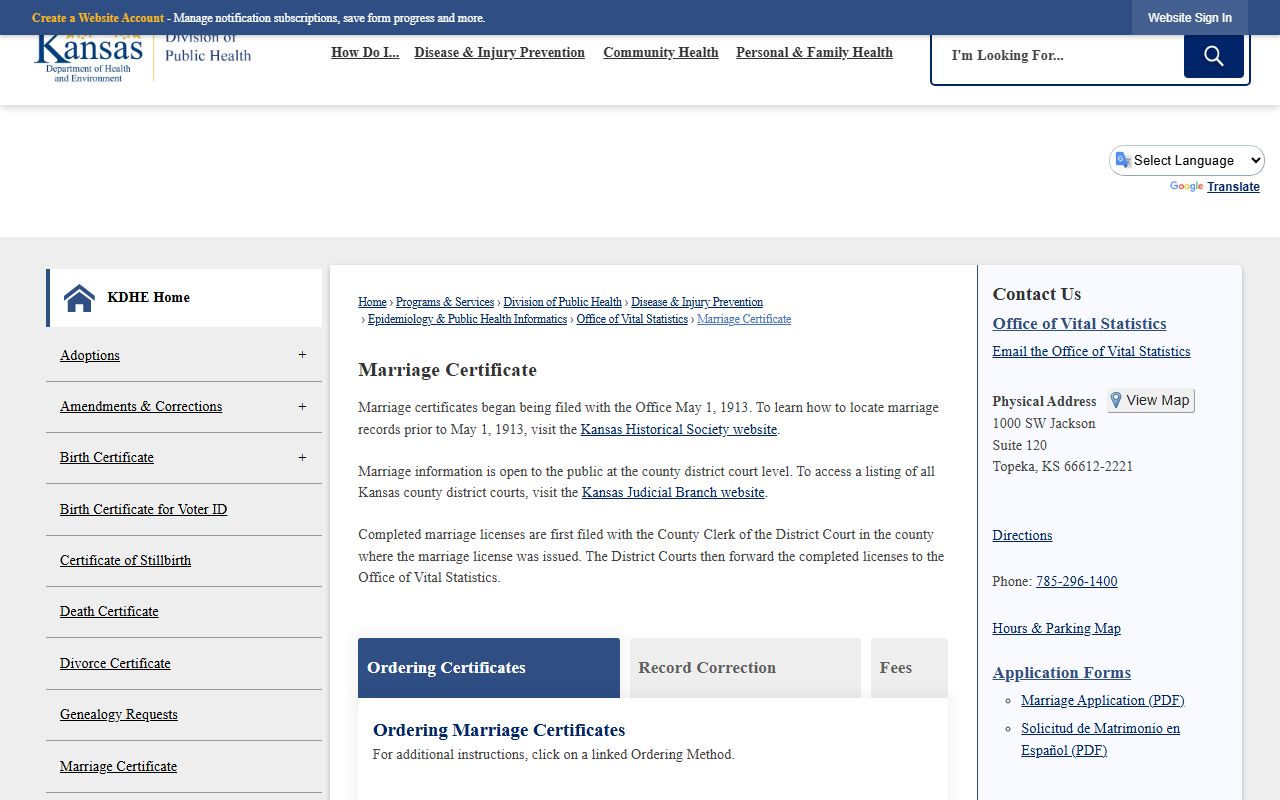
It lists the dates covered, the fees, and the ways to order a certified copy. There is a useful difference between a court record and a vital record here. The court holds the legal case file, including the marriage license return or the full divorce case. The state vital record is a certificate, a shorter official document used to prove the event for things like a name change, a benefit claim, or an immigration matter. Many people need the certificate, not the full file, and starting at the right office saves a wasted fee.
| Item | Amount |
|---|---|
| Kansas marriage license | $85.50 |
| KDHE certified marriage certificate | $20.00 |
| KDHE certified divorce certificate | $20.00 per search/copy |
Sedgwick County Divorce Decrees
A divorce is a court case, so the full record lives with the District Court. The county confirms that divorce records are maintained by the 18th Judicial District Court rather than county government. Only the District Court can provide the full case record, including the divorce decree. KDHE can issue a certificate that documents the divorce, but that certificate is not the decree. For a certified decree, the request goes to the DC18 Records or Family Law Department.
Public divorce case information may show in the court portal, but Kansas Supreme Court Rule 22 excludes dissolution documents from the public portal. So you may see that a case exists without seeing every document online. The court records page covers the portal and its limits.
Filing for Divorce in Sedgwick County
People who file their own divorce can use state forms. Kansas Self-Help and the Kansas Judicial Council provide divorce forms split between cases with minor children and cases without. The process runs through the Family Law Department, and a self-represented litigant follows the court's local rules for filing, service, and any required classes or mediation. A fee waiver, called a poverty affidavit, may be available, and that affidavit is not a public portal document.
The basic path for a self-represented divorce looks like this.
- Decide whether the case involves minor children, since the forms differ.
- Use the Kansas Judicial Council or Kansas Self-Help divorce forms.
- File in Sedgwick County District Court if venue and residency are proper.
- Pay the filing fee or request a fee waiver if eligible.
- Serve the other spouse and follow local family law rules.
- Attend any required hearings, parenting class, or mediation.
- Request a certified decree from DC18 Records or Family Law.
The Kansas divorce self-help page is shown below from the Kansas Judicial Branch.
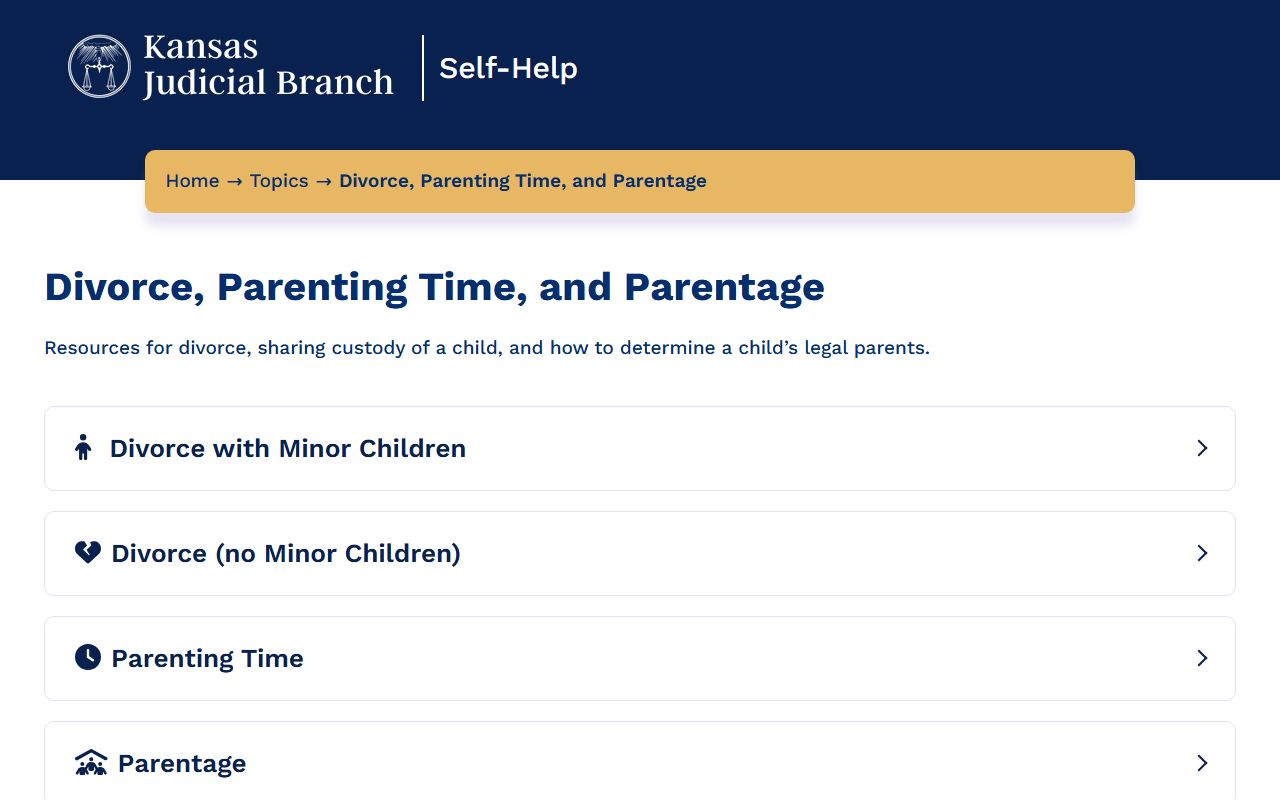
It covers divorce, parenting time, and parentage for people without an attorney. Court staff can hand out forms and explain procedure, but they cannot give legal advice or tell a person what to file, so complex cases are worth a consultation with a lawyer. The FAQ page answers more common questions about these records.
The Family Law Department
The Family Law Department is the court office behind these cases. It handles divorce, paternity, visitation, interstate matters, and protection cases, and it reports about 8,500 family law cases a year. The department sits on the 7th floor of the main courthouse at 525 N Main. Records requests can go to the Records Department or the email used for court records, and certified decrees come from the court rather than the county clerk.
DC18 Family Law Department
525 N Main St, 7th Floor
Wichita, KS 67203
(316) 660-5900
The department also links resources that families often need, including a parenting workshop, the state payment center for support, and protection order help. Protection from abuse and protection from stalking cases are handled in this area but are closed to the public portal under court rule, so identifying details are not posted online. For estate and guardianship matters that sometimes follow a death or divorce, the probate records page covers the Probate Department.