
The Sedgwick County Probate Department
Probate in Sedgwick County is a department of the District Court, not a stand-alone probate court. It sits at a different building than the main courthouse, on East Morris Street, alongside juvenile court functions. The department is responsible for filing and maintaining probate actions and for receiving and disbursing money as the court directs. Probate clerks process about 2,700 cases a year, open new files, enter case information, and issue pleadings. Because the office is separate from the main records counter, a person filing a new probate case goes to East Morris Street rather than to the downtown Records Department.
The Probate Department page is shown below from DC18.
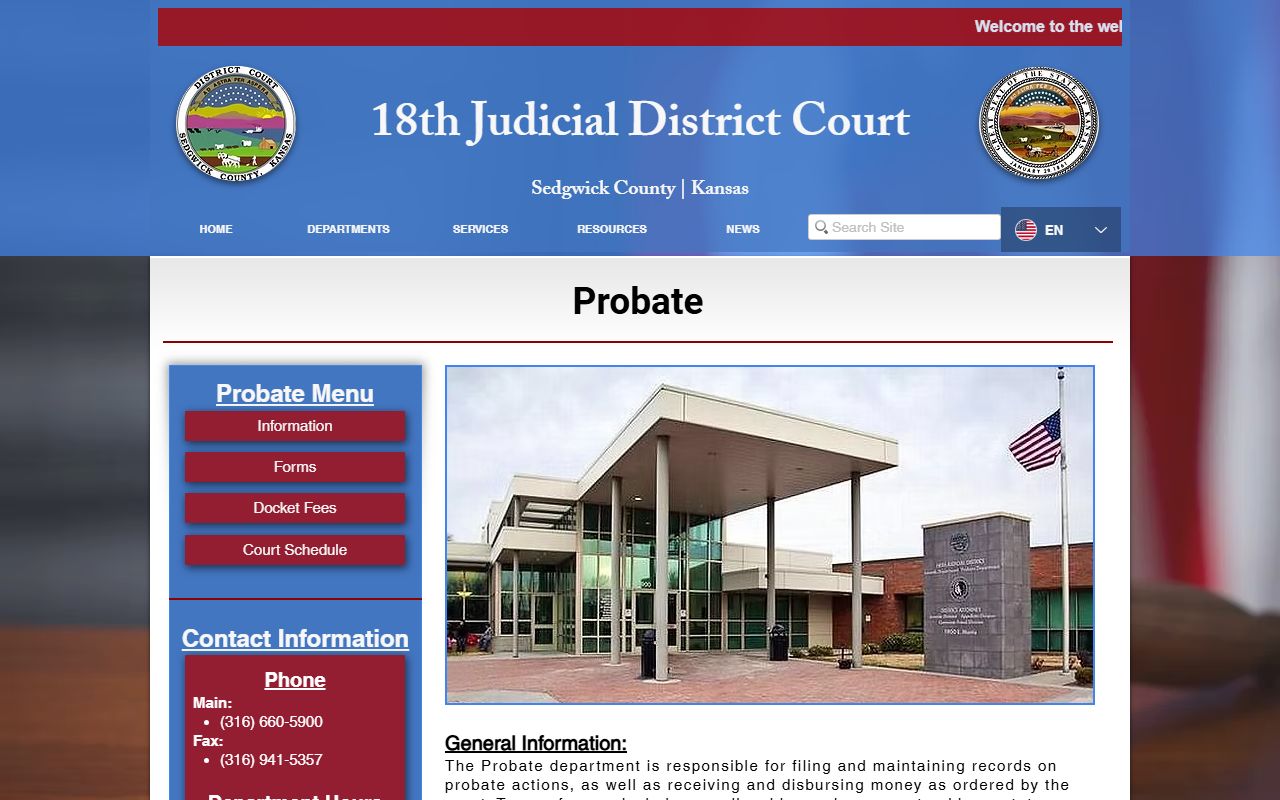
It lists the case types, the confidentiality notes, and the department's contact details.
DC18 Probate Department
1900 E Morris St
Wichita, KS 67211
(316) 660-5900
Mon-Fri 8:00 AM-4:00 PM
Types of Sedgwick County Probate Cases
Probate covers more than wills and estates. The department handles four broad areas, and the rules of access differ by type. Estate administration deals with a person's property after death. Guardianships and conservatorships protect people who cannot manage their own care or finances. Care and treatment cases address mental illness or alcohol and substance issues. Adoptions complete a legal family relationship. The first two areas often have public case listings, while the last two are confidential.
- Estates - administration of a deceased person's property and debts.
- Guardianship - care decisions for a minor or an incapacitated adult.
- Conservatorship - management of another person's money or property.
- Care and treatment - confidential cases for mental health or substance issues.
- Adoption - confidential cases that create a legal parent-child bond.
Estate files can include petitions, the will, orders, an inventory, creditor notices, accountings, and receipts. The mix of public and confidential types is why probate access is not a single yes or no. A creditor checking on an open estate has a very different experience than a person trying to view an adoption or a care and treatment file, which are sealed by law. When in doubt about a specific case, ask the Probate Department what is available before assuming a record is open or closed.
Common Probate Terms
Probate uses words that rarely come up elsewhere, so a short glossary helps. These terms appear throughout estate and guardianship files, and knowing them makes a record far easier to read.
- Testator
- A person who makes a will.
- Executor
- The person named to carry out a will and settle the estate.
- Intestate
- Dying without a valid will, so state law decides distribution.
- Guardian
- A person appointed to make care decisions for another.
- Conservator
- A person appointed to manage another's finances or property.
Confidential Probate Matters
Not every probate file is open. DC18 states that care and treatment cases and adoptions are confidential. Kansas Supreme Court Rule 22 also excludes guardianship and conservatorship documents from the public portal, even when a case listing may appear. Adoption cases filed under the state adoption act are inaccessible through the public portal, and care and treatment cases under the mental illness and substance statutes are closed as well. So a person may confirm that a case exists without being able to view its documents online.
This protects sensitive personal, medical, and family information. For a restricted file, a person with a legal interest usually must ask the court directly and may need to show standing. The court records page explains the broader restrictions under Rule 22.
Sedgwick County Probate Forms
Forms are a big part of probate practice. DC18 maintains a local form library, and the Kansas Judicial Council publishes statewide probate forms for guardianship, conservatorship, and protective proceedings for minors. The court lists items such as an annual accounting form and a guardianship report. Using the correct, current form avoids a rejected filing and a wasted trip.
The DC18 forms library is shown below from DC18.
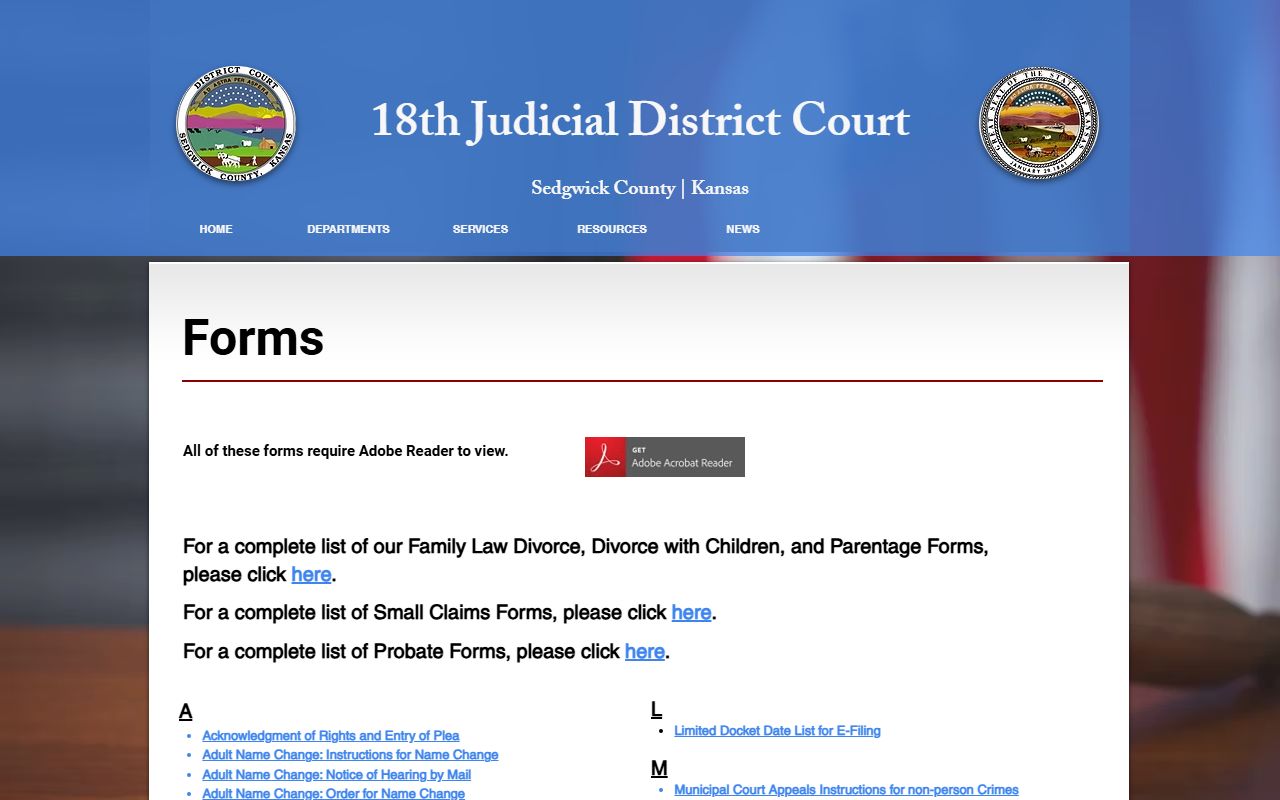
It is the local source for probate and other case-type forms.
How to Search Sedgwick County Probate Records
Public probate case information is searched through the same statewide portal used for other court records, with the restrictions noted above. You search by party or decedent name, or by case number when you have it. Guardianship and conservatorship documents will not appear, and confidential case types are closed. For an open estate file, a case listing may be visible online, but the documents themselves often require a direct request to the Probate Department.
| Field Label | Type | Required | Notes / Format |
|---|---|---|---|
| Party / decedent name | Text | No | Use exact spelling; search by the estate name. |
| Case number | Text | No | Best identifier for a probate file request. |
| Account login / robot check | Login / Challenge | Yes | Required to use the public portal. |
The Kansas Judicial Branch self-help page is shown below from the Kansas courts.
It links record requests, forms, and legal help for self-represented filers. One practical tip applies to every probate search. Use the exact name and, if you can, the case number, because estates are often filed under a decedent's full legal name rather than a nickname. If a search comes up empty, the file may be confidential, the case may predate the electronic index, or the name may be spelled differently in the court system. In those cases, a call or visit to the Probate Department on East Morris Street is the next step.
Estate Administration Steps
Estate cases follow a familiar path. The exact steps depend on whether there is a will and the size of the estate, but the shape is consistent. Each step produces records that become part of the probate file, which is why estate files can grow large over months or years.
- Determine the proceeding type, such as estate administration or will admission.
- Obtain forms from DC18 or the Kansas Judicial Council.
- File in the Probate Department at 1900 E Morris St.
- Pay the docket fee per the DC18 schedule.
- Give notice to heirs and interested parties as required.
- Handle inventory, creditor notice, claims, and accounting.
- Complete distribution and final discharge.
Guardianship and conservatorship cases add ongoing duties, including annual reports and accountings that keep the case under court oversight. Court staff can give forms and explain procedure, but they cannot give legal advice, so an executor or proposed guardian with a complex estate often benefits from counsel. Notice rules are strict, and a missed notice can delay the whole case.
Guardianship and Conservatorship Records
Guardianship and conservatorship are two of the most common probate matters, and people often confuse them. A guardian makes personal and care decisions for a minor or an incapacitated adult, such as medical and living choices. A conservator manages the money and property of a person who cannot handle their own finances. One case can involve both roles, or just one, depending on the person's needs. These cases protect vulnerable people, which is why their documents are kept off the public portal even when a case listing exists.
Once a guardian or conservator is appointed, the work does not end. The court keeps oversight through annual reports and accountings that show how decisions were made and how money was handled. A guardianship report and an annual accounting are standard filings, and missing them can bring the case back before the judge. For families, the practical takeaway is that these are ongoing court relationships, not one-time filings, and the records build up over the life of the case. The FAQ page answers more questions about which probate matters are public.
Probate Filing Fees
Probate cases carry a docket fee set by the court's schedule. DC18 posts a printable docket-fee sheet and cites state law for added county docket-fee authority. The specific probate filing amounts were not harvested from the printable schedule during research, so the safest step is to confirm the current fee with the Probate Department before filing. Copy and certification fees are separate and follow the court's posted schedule.
| Item | Amount |
|---|---|
| Probate docket fee | Per posted DC18 schedule |
| Copy / certification | Per posted DC18 schedule |
A fee waiver may be available for those who cannot pay, through a poverty affidavit, and that affidavit is not a public portal document. Because fees can change with state orders, the posted schedule always controls over any older figure. For the full court records office and copy process, see the Clerk of the District Court page. Estate matters often connect to marriage and divorce records when family relationships are involved.