
Kansas District Courts and the 18th District
Kansas runs a unified court system, and district courts are its trial level. Every county has a district court with original jurisdiction over civil and criminal cases, divorce and domestic matters, damage suits, probate and estates, guardianships, conservatorships, care of the mentally ill, juvenile matters, and small claims. Sedgwick County is the entire 18th Judicial District, so its district court carries a heavy statewide share. The court describes district courts as the front line of the judicial system, the place where most cases begin and most records are made.
Because the district court is a general trial court, a single courthouse can hold a foreclosure, a felony trial, a divorce, and a probate estate on the same day. That breadth is why the court records system is split into departments, each with its own staff and case codes. The court records page explains how to search across these case types.
Judges and Staff of the District Court
The 18th Judicial District is large. The court reports 30 district judges and one magistrate judge, supported by about 240 non-judicial personnel. That staff includes administrative aides, court reporters, clerks, court service officers, and court trustees. The chief judge controls case assignments and supervises the clerical and administrative side of the court. Jury service follows set rules, with 12 jurors for a felony, 6 for a misdemeanor, and usually 12 in civil cases where 10 can reach a verdict.
This scale shapes how records flow. With so many judges and divisions, the daily docket runs long and updates every 15 minutes, and case files move through department clerks rather than a single counter. The court dockets page covers the daily and weekly calendars these judges set.
District Court Departments and Locations
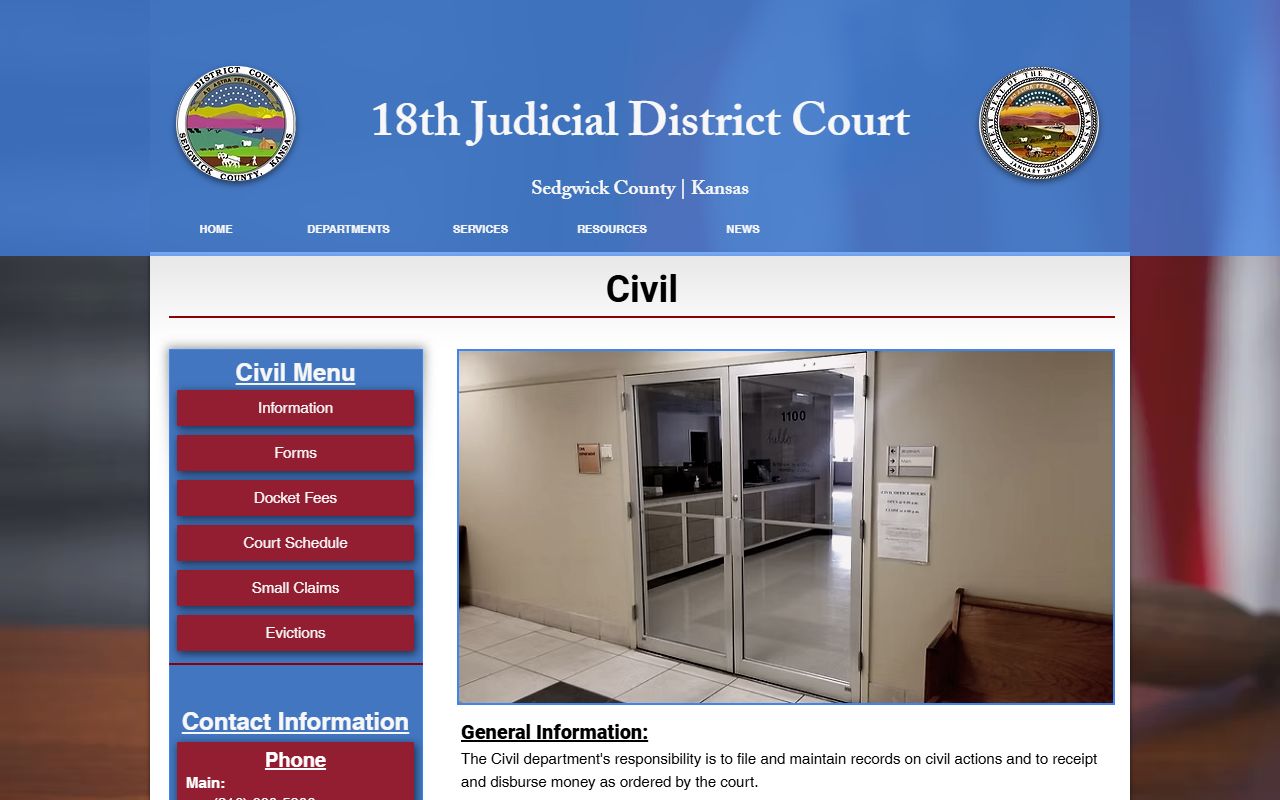
The District Court is organized into departments rather than separately numbered courthouses. Most sit in the main courthouse at 525 N Main, while probate and juvenile functions are at 1900 E Morris St. The civil department page is shown below from DC18, with its address, hours, and case-type detail.
| Department | Location | Phone | Handles |
|---|---|---|---|
| Records Department | 525 N Main, 6th Floor | (316) 660-5900 | Court records, microfilm, copies |
| Civil Department | 525 N Main, 11th Floor | (316) 660-5900 | Civil, limited civil, small claims |
| Criminal Department | 525 N Main, 7th Floor | (316) 660-5900 | Felony, misdemeanor, warrants |
| Family Law Department | 525 N Main, 7th Floor | (316) 660-5900 | Divorce, paternity, protection |
| Traffic Department | 525 N Main, 7th Floor | (316) 660-5900 | County and highway citations |
| Probate Department | 1900 E Morris St | (316) 660-5900 | Estates, guardianships, adoptions |
The family law department page is shown below from DC18.
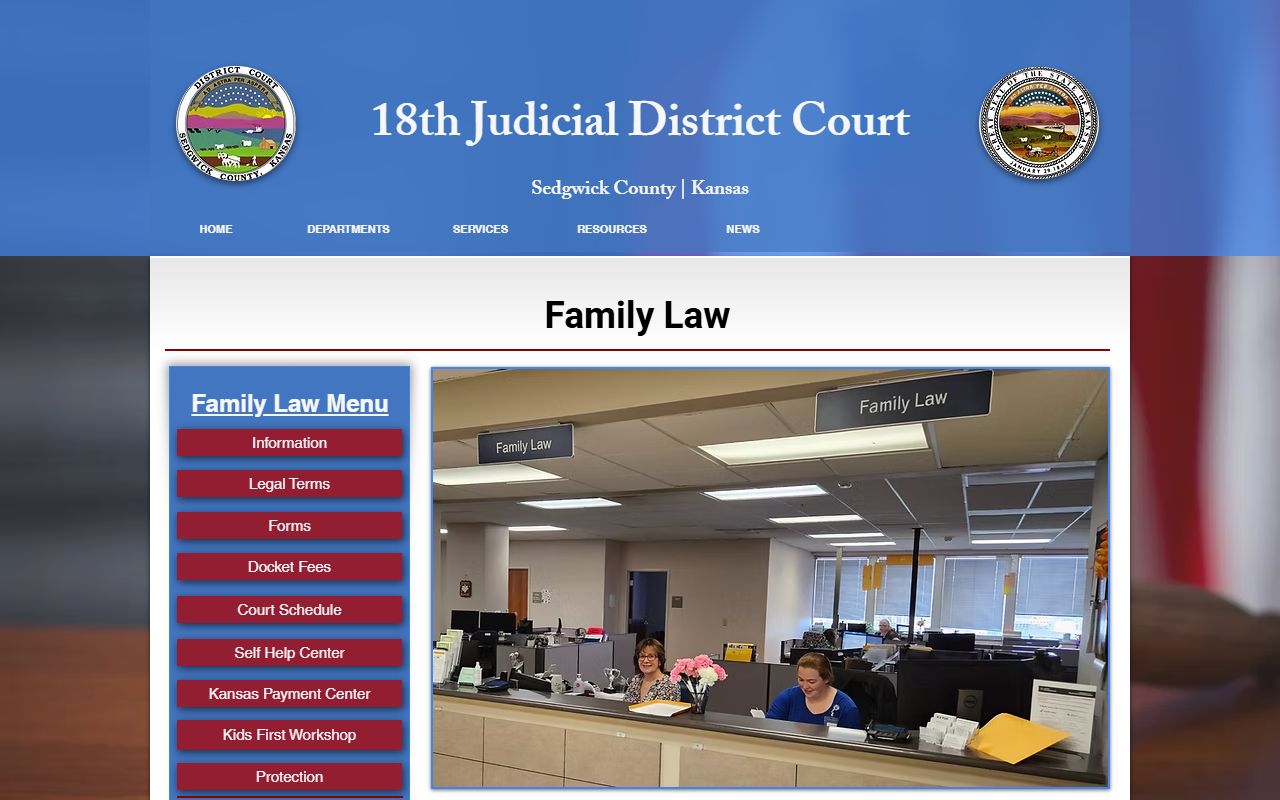
It covers divorce, paternity, visitation, and protection cases. Most departments share the main courthouse phone line, so the floor and case type matter more than a unique number when you visit. The probate and juvenile building on East Morris Street is the main exception, and it keeps its own hours.
How a Case Moves Through the System
Kansas cases follow a clear path from the trial court upward. A city ticket may begin in a municipal court, while a state case begins in the District Court. Appeals climb from there. The flow is simple to picture.
Case flow: Municipal Court › District Court › Kansas Court of Appeals › Kansas Supreme Court
The District Court is the level where most records are made and most cases are decided. The Court of Appeals hears most appeals, and the Supreme Court takes the most serious and constitutional matters. Municipal courts handle city ordinance and city traffic cases first, and the District Court hears appeals from them.
| Point | District Court | Municipal Court |
|---|---|---|
| Authority | State trial court, general jurisdiction | City court, ordinance matters |
| Case types | Civil, criminal, family, probate, traffic | City ordinance and city traffic |
| Appeals | To the Kansas Court of Appeals | To the District Court |
Small Claims and Self-Represented Cases
The District Court also runs small claims, built for people without lawyers. Small claims covers recovery of money or property up to $10,000, with no jury and attorneys generally not used. The judge hears the case and decides. Hearings run Monday through Thursday, with trials and motions in the early afternoon. Court clerks can give forms and procedure but cannot give legal advice.
The small claims page is shown below from DC18.
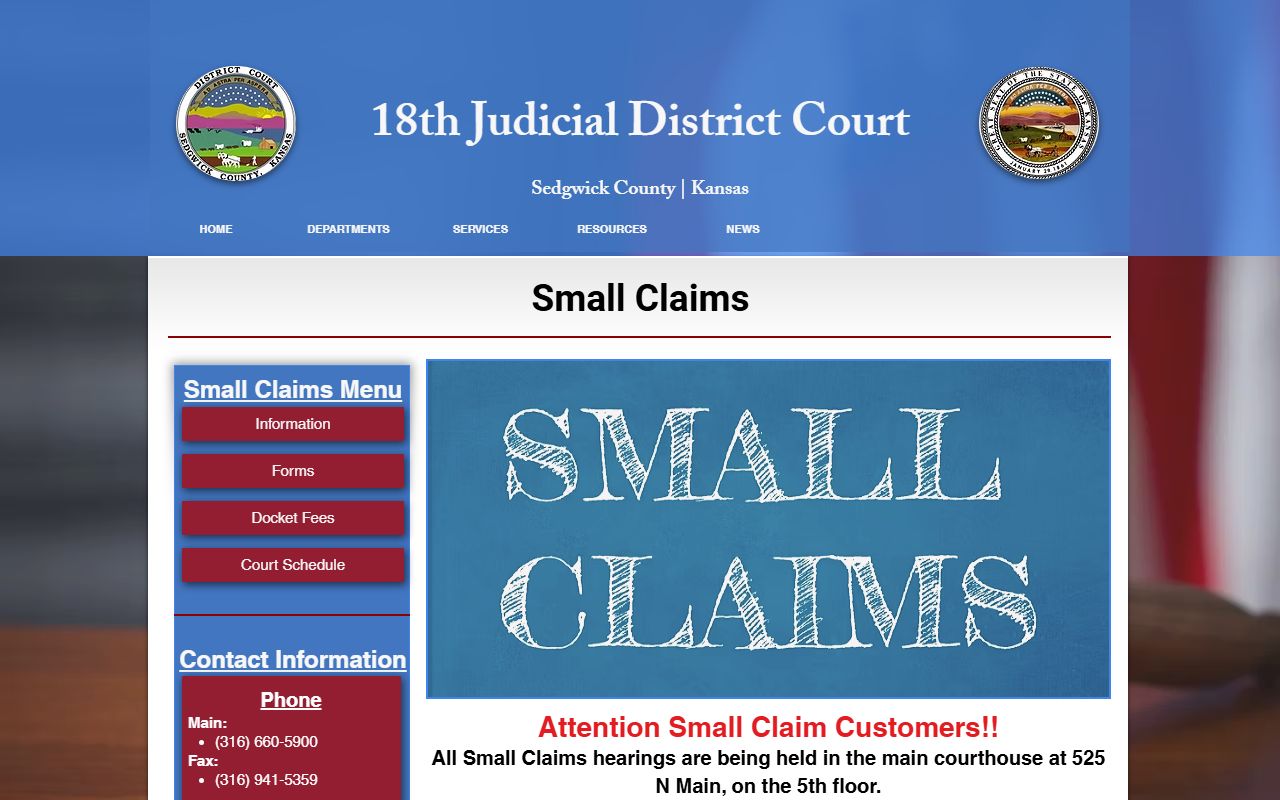
It lists the $10,000 limit, hearing times, filing methods, and the forms a filer needs. Filing can be done in person, by mail, or through a drop box, and a self-represented litigant certification is required with small claims forms. In-person payment can be cash, check, money order, or a major card, while mail and drop box payments must be check or money order. These details make small claims one of the most accessible parts of the District Court for ordinary residents.
Specialty Courts
The District Court operates problem-solving courts alongside its regular docket. The Veterans Treatment Court is a voluntary five-phase program of about 18 months for justice-involved veterans, with a mentor for each participant. A Drug Court also runs, assigned to a civil division judge. These programs use treatment and close court contact to reduce repeat offenses, and they draw on partners such as the VA, the District Attorney, and the Department of Corrections.
The Veterans Treatment Court sets clear eligibility, including military service, county residency, a discharge other than dishonorable, a qualifying felony charge or probation violation, and VA healthcare eligibility. Participants agree to treatment, drug testing, court appearances, and mentor meetings over the length of the program. Specialty-court records follow the same access rules as other cases, with many documents restricted to protect participants. The arrest records page covers the District Attorney's separate diversion programs.
Visiting the District Court Courthouse
The main courthouse stands at 525 N Main St in downtown Wichita, near Elm, Pine, and Murdock streets. The courthouse is open Monday through Friday from 8:00 AM to 5:00 PM, while clerk hours run from 8:00 AM to 4:00 PM. DC18 routes visitors to the county parking garage rather than a curbside drop-off. The garage sits at the northwest corner of Elm and Main, with the entrance from Main, and jurors can have their tickets validated by the Jury Clerk.
Accessibility is handled by a local coordinator. ADA Coordinator Joni Wilson works from the 11th floor and can be reached at (316) 660-5801 or TDD 711, and the court asks for accommodation requests at least five working days before a proceeding. Allow extra time for downtown parking, elevator travel, and security screening when you have a hearing. The probate and juvenile building on East Morris Street is a separate stop, so confirm which location your matter uses before you travel.
History and Technology of the Court
The unified Kansas court system grew from a 1972 constitutional change that placed judicial power in a single statewide system under the Supreme Court. The 18th Judicial District has expanded with the Wichita region and now ranks among the busiest trial courts in Kansas. Its caseloads are heavy across the board, with roughly 27,000 civil filings, 8,500 family cases, 20,000 traffic citations, 3,000 criminal cases, and 2,700 probate cases in a year.
Technology has changed how the public reaches the court. Administrative orders moved the court toward electronic record preservation, electronic filing, and mandatory e-filing for attorneys. The court now points the public to the statewide CaseSearch portal rather than a local database, and its daily docket refreshes every 15 minutes. These steps make many records reachable from home, though older files still live on microfilm at the Records Department. The court also publishes some rules and navigation in Spanish and Vietnamese, a sign of the language needs in a county of more than 500,000 residents. Even with strong online tools, the courthouse counter remains the place for certified copies and for records the portal does not show.
Federal Courts and the Appeals Path
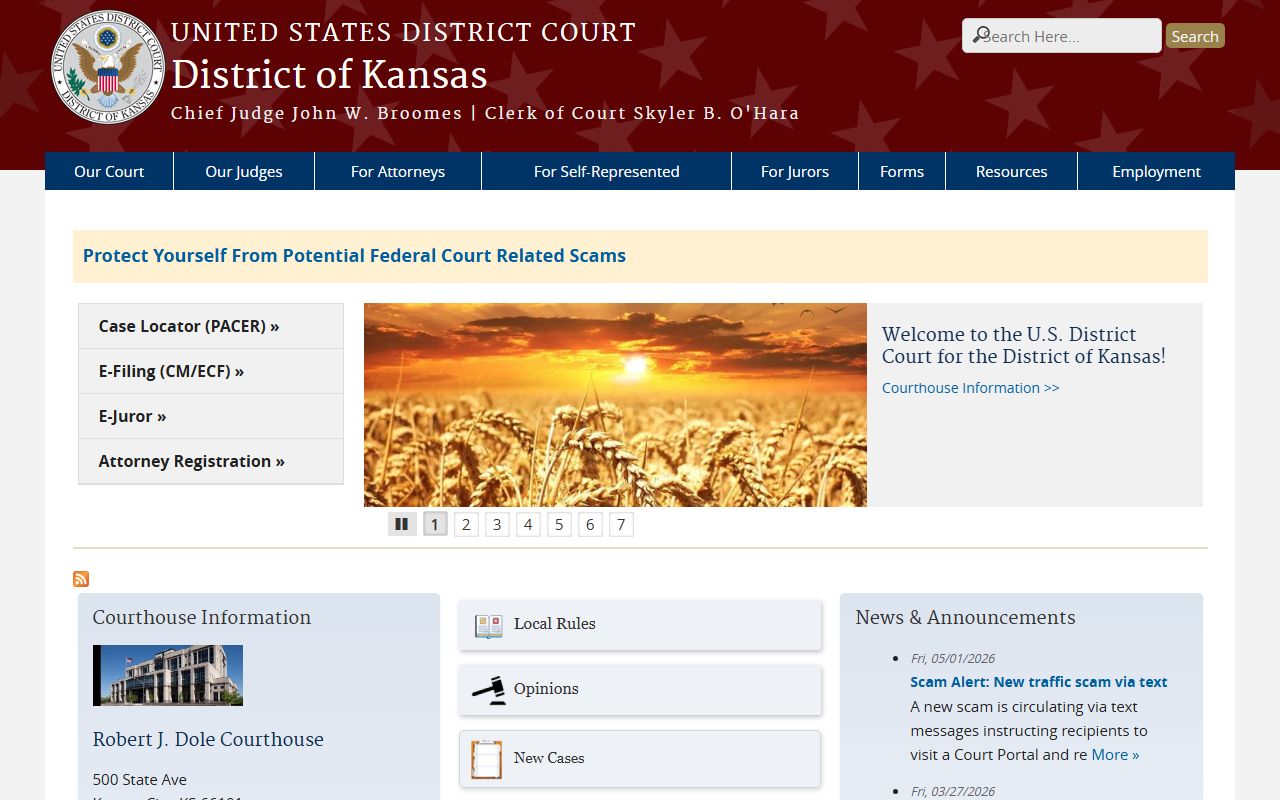
Some Wichita cases belong in federal court, not the District Court. Federal crimes, civil rights suits, and federal-question cases go to the U.S. District Court for the District of Kansas. Its page is shown below from the federal court.
Bankruptcy is its own federal court, shown here from the U.S. Bankruptcy Court for the District of Kansas.
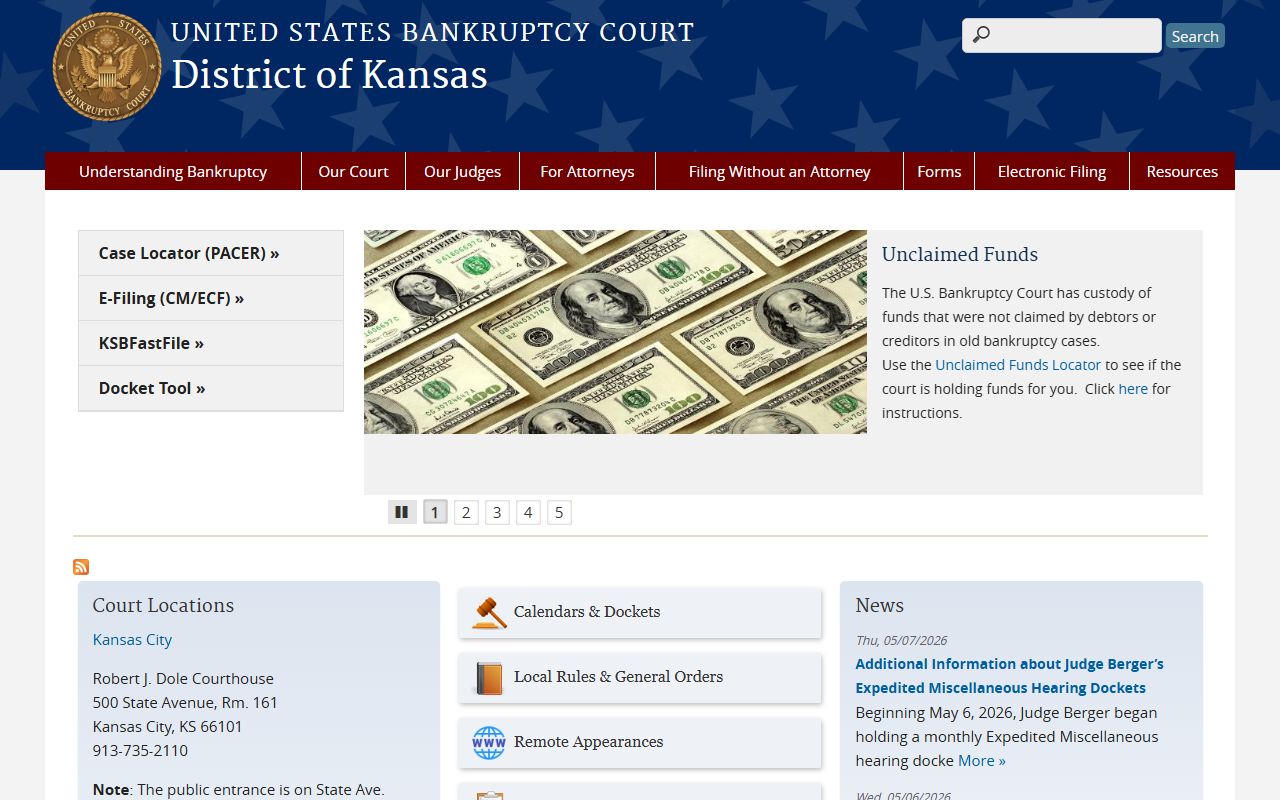
Kansas federal appeals go to the U.S. Court of Appeals for the Tenth Circuit. Federal records live in PACER, while state appeals from the District Court go to the Kansas Court of Appeals and the Kansas Supreme Court. The court records page and the Clerk of the District Court page cover state case files.