
How to Find Recent Sedgwick County Arrests
The fastest way to see a recent arrest is the Sheriff's inmate search, which lists people currently held in the Sedgwick County jail. You search by first and last name and clear a robot check. This tool reflects current custody, so a person who has bonded out or moved to another agency may drop off the list. For the criminal case that follows an arrest, you move to the Kansas District Court Public Access Portal, which carries charges, hearings, and dispositions for the 18th Judicial District. The two systems work together. The jail roster tells you who is in custody now, and the court portal tells you what the State has charged and how the case is moving.
Before you search, gather a full name and any case or booking number you have. Common Wichita surnames return long lists, so a middle name or a date of birth helps. The Criminal Department files and maintains felony and misdemeanor records, search warrants, and inquisitions, and reports about 3,000 cases a year. Its case page is shown below from the DC18 Criminal Department.
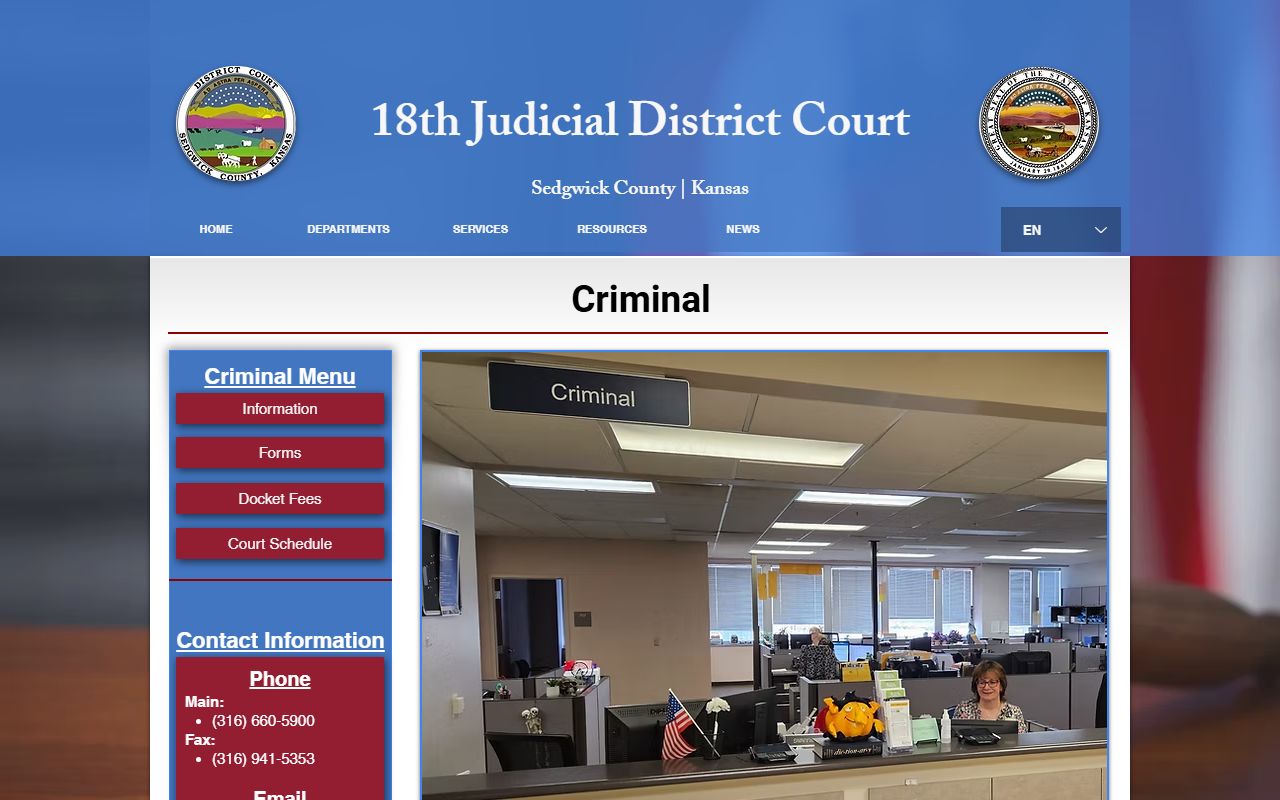
That page lists the department's scope and contact details for criminal court records. The Criminal Department sits on the 7th floor of the main courthouse at 525 N Main, and records requests go to the 6th-floor Records Department or the email sg.micro@kscourts.gov.
- Search the Sheriff's inmate tool by name to check current custody.
- Note the booking name and any case number shown.
- Open the Kansas court portal and search the same name.
- Review the charges, hearing dates, and disposition.
- Request certified criminal court records from the Records Department.
Arrest Record vs Criminal Court Record
An arrest record and a criminal court record describe different stages and come from different offices. The arrest record is created by law enforcement when a person is booked into the jail. It shows the booking and current custody status. The criminal court record begins when the State files charges and runs through the District Court. It shows the formal charges, the plea, the hearings, and the final outcome. A person can be arrested and never charged, and a charge can be dismissed or reduced. That is why you should never treat a booking alone as proof of guilt.
| Point | Arrest Record | Criminal Court Record |
|---|---|---|
| Created by | Sheriff's Office at booking | District Court when charges are filed |
| Shows | Booking, custody status | Charges, plea, hearings, disposition |
| Search at | Sheriff inmate tool | Kansas CaseSearch portal |
| Means guilt? | No | Only if a conviction is entered |
For the custody side, the Sedgwick County inmate records page covers the jail roster in full; for the full case file, see court records.
Charges vs Convictions in Sedgwick County
The single most common mistake in reading a criminal record is treating a charge as a conviction. A charge is an accusation the prosecutor must prove. A conviction is the finding or plea of guilt that ends a case against a defendant. Between those two points, a case may be diverted, amended, or dismissed. The disposition line in the court record is the only reliable place to learn the outcome. A record that shows a felony charge but a misdemeanor conviction, or a dismissal, tells a very different story than the charge alone.
Public criminal case information generally includes the case number, the defendant, the charges, the hearings, the judge, the attorneys, the disposition, and any fines or costs. Some material is held back. Probable-cause affidavits, presentence reports, sealed information, expunged matters, and some victim details are restricted. Read the whole record, not just the top line, before you draw a conclusion.
Mugshots, Booking, and the Jail
The Sheriff's Office runs the Adult Detention Facility at 141 W Elm in Wichita, which serves as the criminal justice entry point for the county. Booking happens here, and the facility houses up to 1,500 inmates. The public inmate search shows current custody by name. Its disclaimer is blunt: the data is public record on people currently in custody, may not reflect a person's actual current location, and may not be used for unlawful purposes. The office warns that anyone who republishes the data is responsible for inaccurate or improper disclosure claims.
Mugshot and booking-photo fields are not confirmed in the public material, so this page does not promise them. To confirm a booking or a release in real time, call the jail main line at (316) 660-5245. For population trends and capacity, the jail population data page has the figures, and the released inmates page explains how to confirm a release.
Warrants and Outstanding Charges
Some arrests start with a warrant. The Sheriff's Office posts an active warrant search where you enter a last and first name. The office stresses that results are possible active warrants, not confirmation or probable cause, and should not be used for legal action. If you believe you have a warrant, the safer path is to contact the Warrant Section at (316) 660-3960 or speak with an attorney before you act. Bench warrants often issue for a missed court date, and traffic warrants can affect a driver's license.
For the full process, the Sedgwick County warrant records page covers warrant types and how to resolve one. Do not approach or try to detain anyone listed on a warrant search.
Statewide Criminal History and Records
A county court file is not the same as a statewide criminal history. The Kansas Bureau of Investigation runs a fee-based criminal history record check that pulls reportable arrests and convictions from across the state. State prison custody and parole status sit with the Kansas Department of Corrections, searchable through the KASPER tool. These state systems are separate from a Sedgwick County criminal records search and serve different needs, such as background screening or supervision status.
Federal cases form yet another layer. The U.S. Attorney's Office prosecutes federal crimes in the District of Kansas, and those cases live in PACER, not CaseSearch. The U.S. Attorney's page is shown below from the Department of Justice.
Federal prosecutions from Wichita are handled here rather than in the county District Court.
Diversion and the District Attorney
Not every case ends in a conviction. The District Attorney runs a criminal adult diversion program, which is a privilege rather than a right. Nonperson crimes may qualify, but severity level 1 through 3 crimes, many drug and weapons offenses, sex offenses, and death cases are excluded. An application must be filed with fees within 30 days of the first preliminary control date, and the office weighs restitution, victim input, and responsibility. A non-refundable $45 criminal history fee and a $45 application fee are listed.
The diversion guidelines are shown here from the Sedgwick County DA.
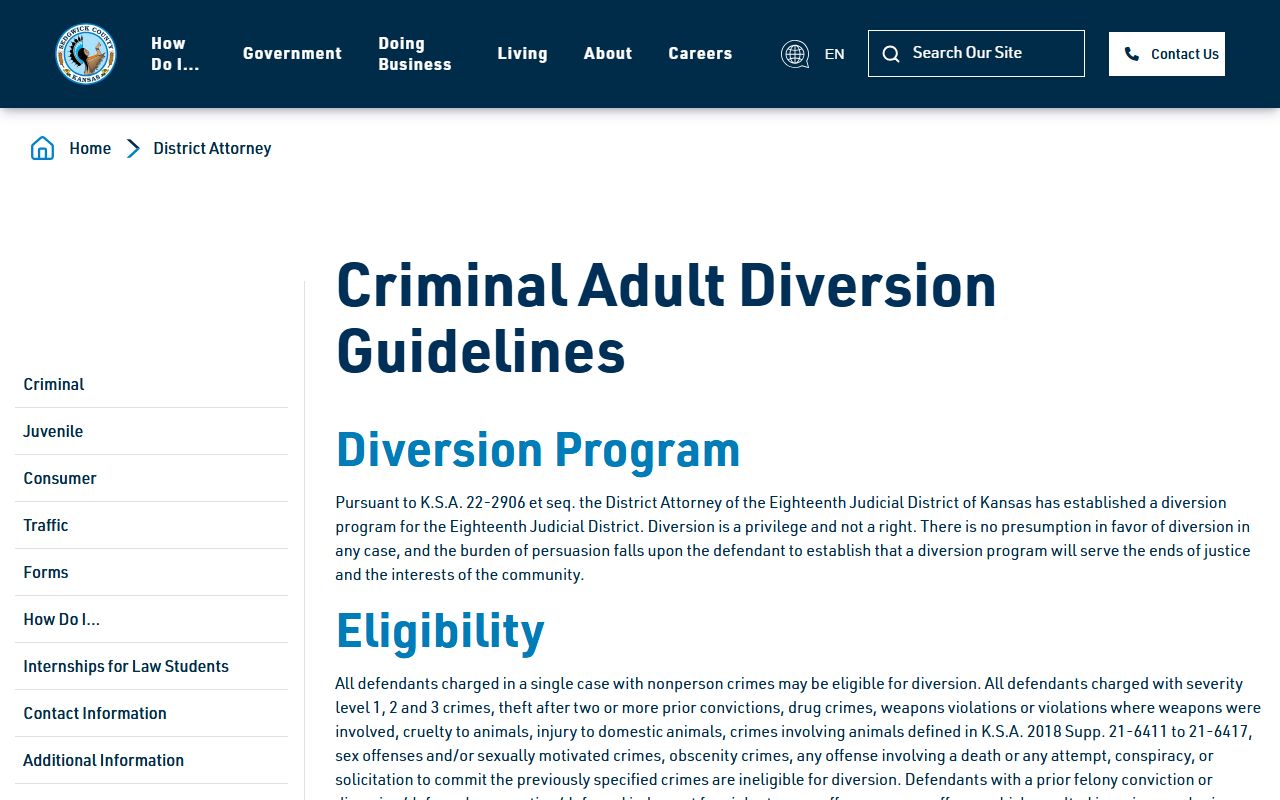
A completed diversion can change how a record reads, which matters for later expungement.
Expunging a Sedgwick County Criminal Record
Kansas uses expungement rather than a single sealing term for many criminal and arrest records. Two statutes do most of the work. K.S.A. 21-6614 covers expungement of certain convictions, arrest records, and diversion agreements. K.S.A. 22-2410 covers arrest-record expungement, including arrests based on mistaken identity. A person files a petition in the district court where the case arose, pays any required fee unless waived, and gives notice as the statute requires.
If a judge grants the order, the clerk sends certified orders to agencies such as the Kansas Bureau of Investigation, and public access is restricted. Expungement does not erase a record for every purpose, since law enforcement and licensing exceptions can still apply. Common reasons for denial include an ineligible offense, a short waiting period, unpaid obligations, pending charges, or a registration requirement.
People mix up sealed and expunged records, but they are not identical. A sealed record is hidden from public view by law or court order while it still exists. An expunged record goes through a specific statutory process that limits access and, in many uses, lets a person say the event did not occur. Both keep the file off the public portal, yet the legal effect differs.
| Point | Sealed Record | Expunged Record |
|---|---|---|
| How it happens | Court order or statute hides the file | Petition under K.S.A. 21-6614 or 22-2410 |
| Public access | Removed from public view | Removed from public view |
| Exceptions | Law enforcement and court access remain | Law enforcement, licensing, and statutory uses remain |
Note: Court clerks can give forms and procedure but cannot give legal advice, so consider counsel before filing an expungement petition.